Guide ·
Crypto Travel Rule 101: Requirements, Thresholds and Blockchain Data
What the crypto Travel Rule requires, the thresholds in the US, EU and FATF guidance, how self-hosted wallets are treated, and how to tell who's on the other side of a transfer
SUMMARY
The Travel Rule requires exchanges and custodians to share sender and recipient details when funds are moved between each other, so that receiving firms know who is behind a transfer before crediting it.
Details shared vary by jurisdiction. They usually include the sender's name and account or wallet address, plus one way to identify the sender (such as a home address, ID number, or date and place of birth), and the recipient's name and account or wallet address.
The US threshold for the Travel Rule is $3,000, the FATF’s reference level is USD/EUR 1,000, and Singapore’s threshold is S$1,500. The EU does not use transaction value as a threshold for crypto Travel Rule transfers.
Transfers between two private self-hosted wallets are out of scope from the Travel Rule because no regulated firms are involved.
HOW TO TELL IF A COUNTERPARTY IS A VASP OR A SELF-HOSTED WALLET WITH ARKHAM
The full exchange of sender and recipient data only happens when a regulated company sits on both ends of a transfer. As a result, the questions a user should ask are where the outgoing payment is going and how much is being transferred. Because exchange deposit addresses and someone’s personal wallet are both strings of letters and numbers, it can be hard to tell them apart. However, using Arkham’s entity attribution telling them apart becomes a lot easier.
Below is a step by step guide to check if a counterparty is a VASP or a self-hosted wallet. If you’re new to Arkham, our guide to using Arkham Intel covers the basics of using the platform.
Paste the destination address into Arkham’s Explorer.

Look for an entity name. If Arkham has already attributed that address to a known entity, the entity’s name, logo, and category (ex. exchange) will appear. Exchanges and Custodians qualify as VASPs, so the Travel Rule can apply to both of these types of entities. Note: An Arkham exchange label shows what an entity does, not whether it is licensed.

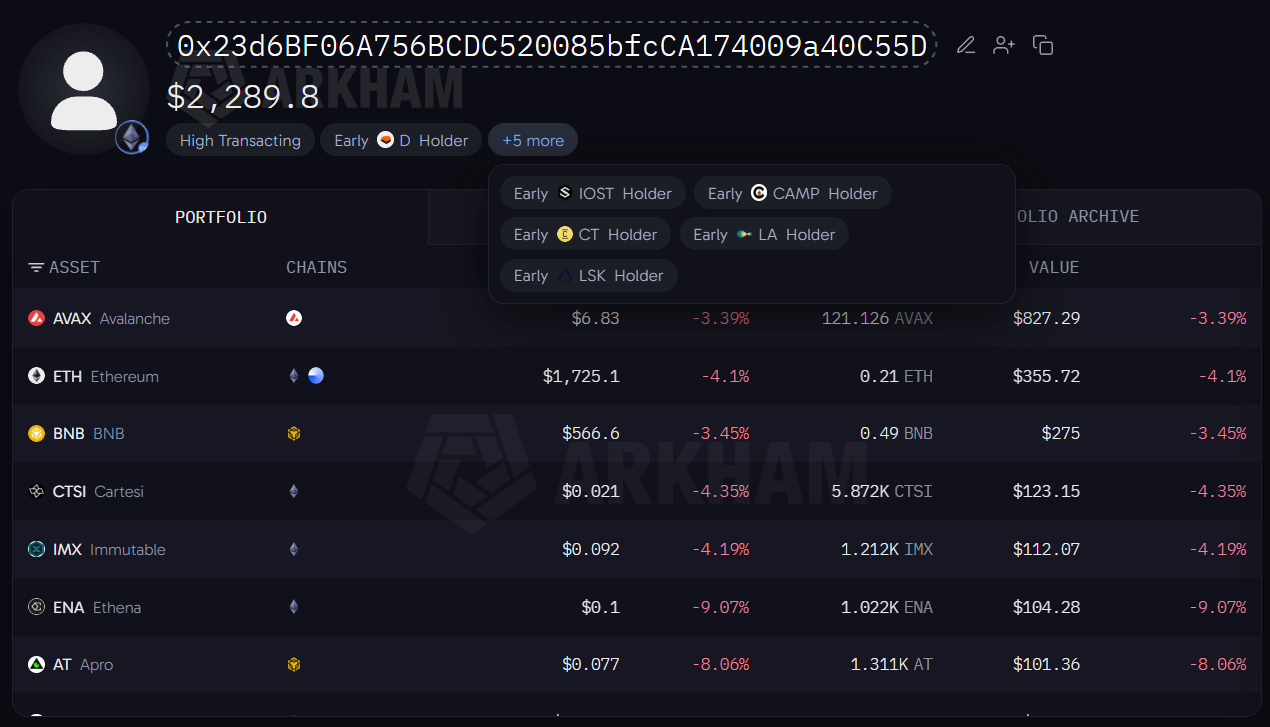
If there is no entity, read what you do get. An address that has no entity matched to it will show raw transaction history, wallet balance, and behavior tags (ex. airdrops received, governance activity). This is typically what a self-hosted wallet looks like.
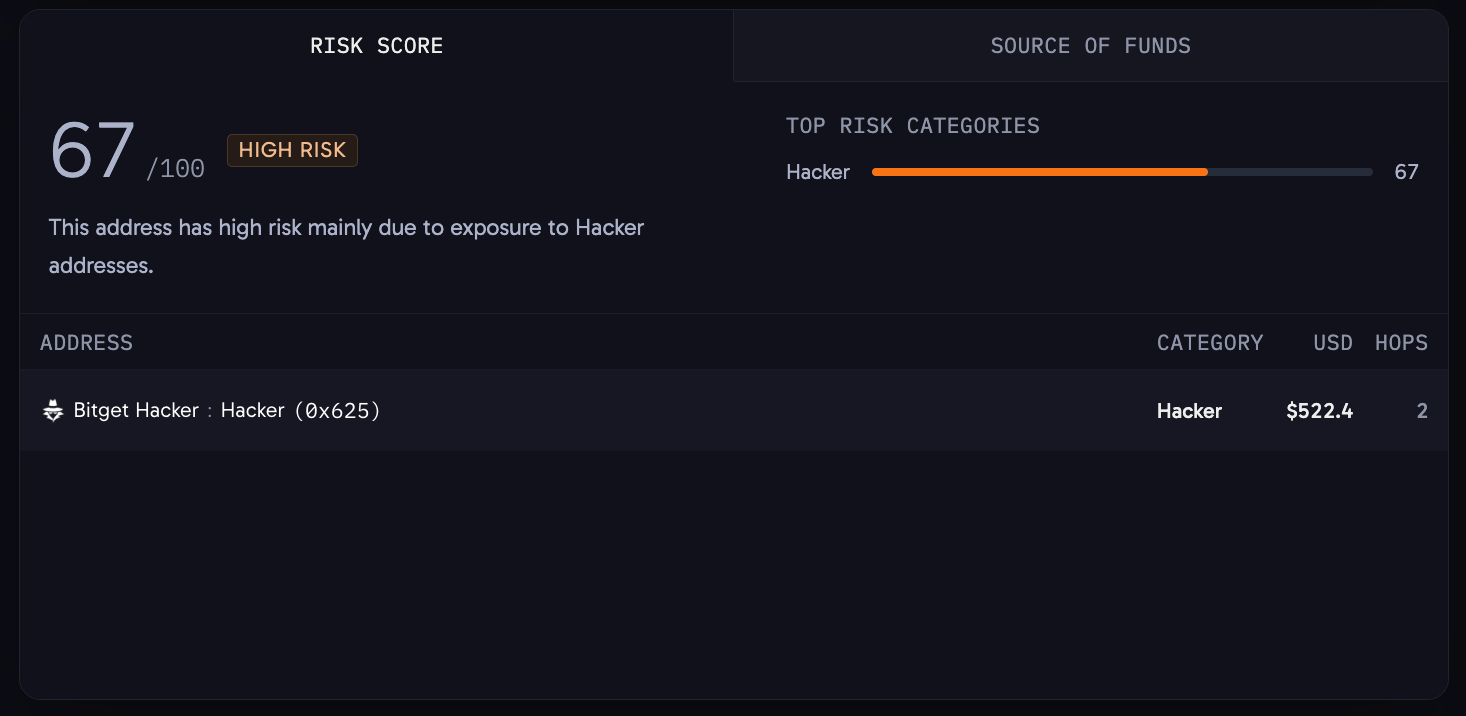
Check Arkham’s Risk Scores feature for the address. Arkham assigns a risk score from 0 to 100 for all wallets, with exposure to sanctioned addresses, hacks, and mixers contributing to a higher risk score. This forms the basis of wallet screening, and is part of the same pre-send check. Wallets can also appear on a sanctioned list, which is a separate problem from the Travel Rule, and one transfer may have both.
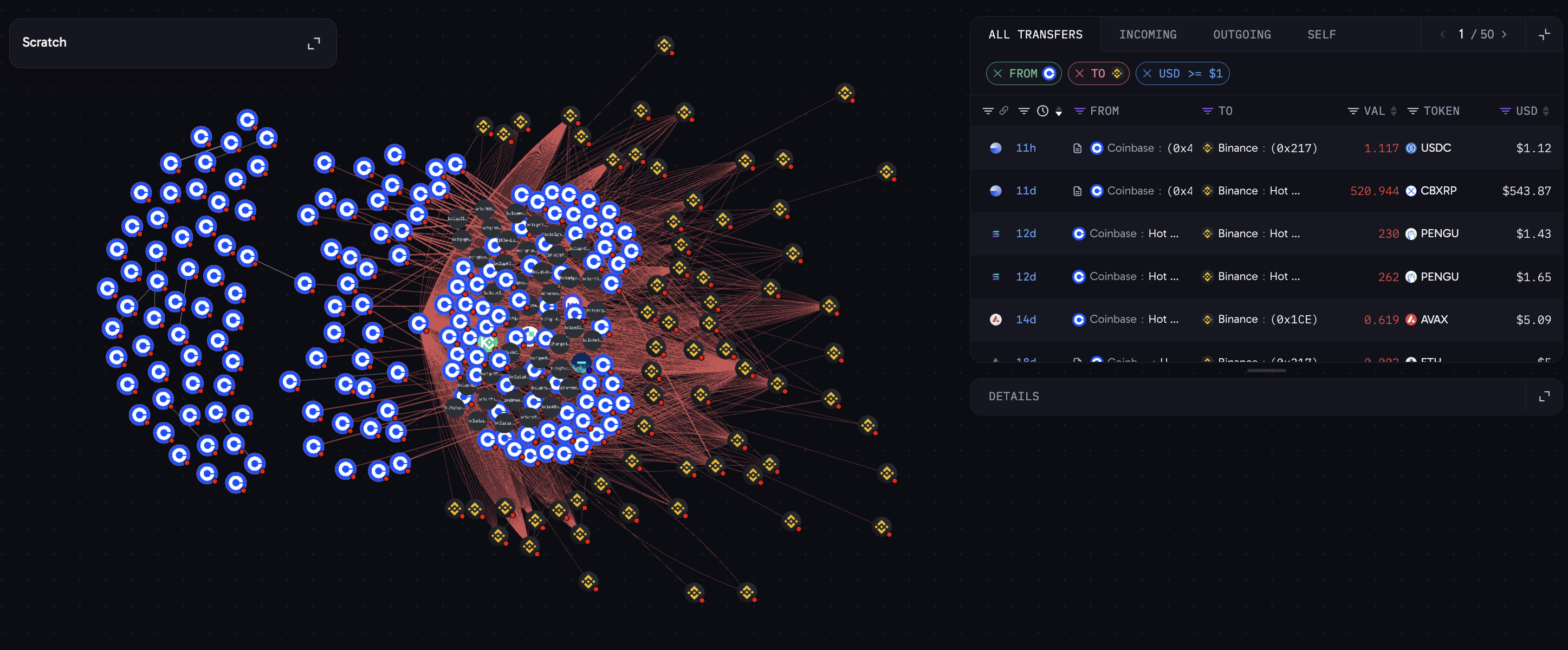
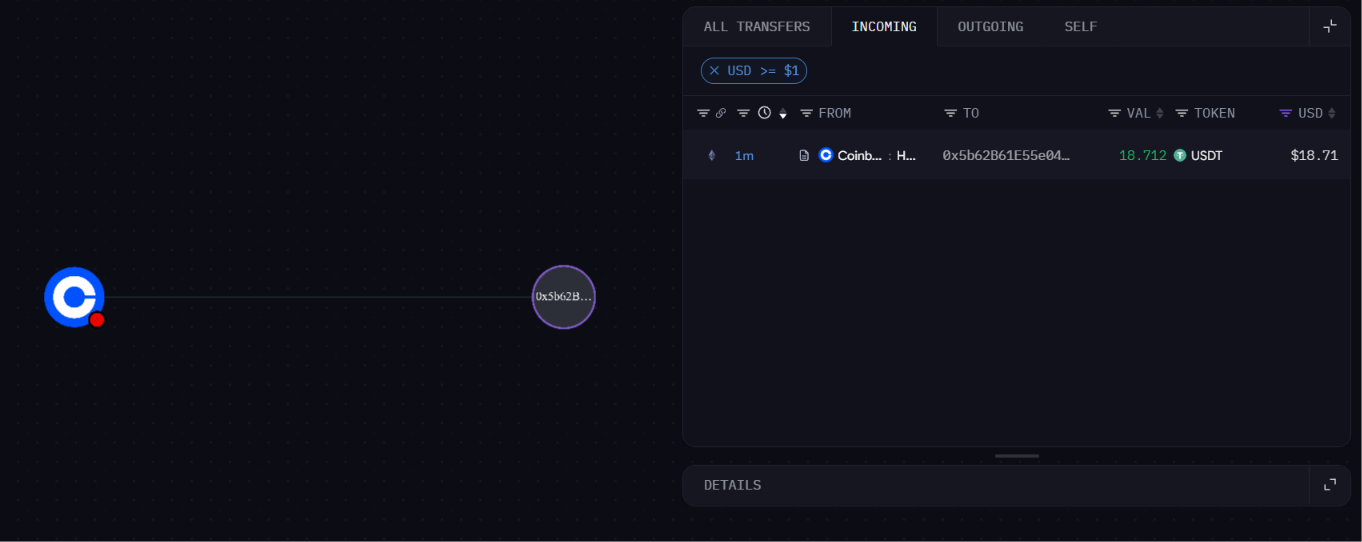
Look at a real exchange-to-exchange transfer. Open a transaction flow between two exchanges in Arkham’s Visualizer, or filter the transfers table by entity. When both ends of a transaction are labeled as exchanges or other custodians, the Travel Rule likely applies because both entities are VASPs. Our previous article on on-chain analysis shows how to dive into deeper transaction analysis.
Whether the Travel Rule applies or not depends on who is on the other side of a transaction, and entity attribution can answer that before a transfer goes out. It’s worth keeping in mind however, that an unlabeled wallet is not necessarily a private wallet. It’s entirely possible that an unlabelled wallet is an exchange wallet that hasn’t been identified as one yet.
Set It Up With the API
Checking if a wallet belongs to a regulated firm or an individual can be done automatically before withdrawals. The Arkham API can look up addresses and return an entity match and labels. An API key is required in order to do this and can be requested here.
The full endpoint list sits in the API documentation. Heavier endpoints, such as /transfers and /counterparties/address/{address}, are limited to one request per second, so queue bulk checks accordingly.
A simple rule set a regulated firm might use as part of their process looks like this:
Entity matched and it is a VASP: route the transfer into your Travel Rule messaging flow.
No entity: hold the transfer for self-hosted wallet checks and ask the customer who controls the address.
High risk score or sanctions exposure: block the transaction and send it to compliance.
WHAT IS THE CRYPTO TRAVEL RULE?
The Travel Rule is an anti-money laundering regulation that requires VASPs (Virtual Asset Service Providers) to collect and share identifying information about the sender and recipient of funds when said funds go to another regulated service provider. Exchanges, custodians, and brokers all qualify as VASPs.
The Travel Rule originated in traditional finance’s bank wires, but applies to crypto as well. In 1996, the US Treasury and Federal Reserve rules requiring US financial institutions to pass sender details alongside fund transfers took effect. Today, these rules are outlined under 31 CFR 1010.410(f), and apply to transfers worth $3,000 or more.
FinCEN’s 2019 guidance applied the existing US rules to crypto exchanges, and the EU wrote crypto into Regulation (EU) 2023/1113, applied from 30 December 2024.
FATF, the global standard setter for anti-money laundering, separately brought crypto into its standards. In October 2018, the FATF amended recommendation 15 to bring virtual assets and VASPs into scope. In June 2019, it instructed countries to apply Recommendation 16’s wire transfer rules to virtual asset transfers.
WHAT INFORMATION MUST BE SHARED?
The information that needs to be shared varies by jurisdiction. In the United States, the following information is required to be shared by financial institutions.
About the sender: name, address and account number.
About the transfer: the amount, the execution date and the name of the recipient’s firm.
About the recipient: whatever the sending firm received, such as name, address or account number.
The shared information is not included in blockchain transactions. This information is shared through messaging channels off-chain.
TRAVEL RULE THRESHOLDS BY JURISDICTION
Jurisdiction | Threshold | What happens at the threshold | Source |
United States | $3,000 | Transmission and recordkeeping duties apply to transfers of $3,000 or more | |
FATF (global standard) | Optional, Up to USD/EUR 1,000 | Above threshold: names, account or wallet numbers, and the originator's address, ID number, or date and place of birth. Below threshold: names and account or wallet numbers only. (A June 2025 revision of Recommendation 16 adds more fields for cross-border payments. FATF guidance on applying it is pending.) | |
European Union | None for crypto transfers | Same data required whatever the amount. €1,000 only matters for ownership checks on self-hosted wallets | |
Singapore | S$1,500 | At or below: names and account numbers for both sides. Above: adds the sender's address, ID number or date and place of birth, and the sender's identity must be verified |
Transfers with no regulated financial institution on either side of the transaction may be exempt, and some regimes exempt firms that are moving their own money. Small transactions are exempt in the US, but not in the EU or Singapore.
SELF-HOSTED WALLETS AND THE TRAVEL RULE
Self-hosted wallets are wallets that you possess the keys for. Nobody holds the wallet for you, and nobody has verified who you are. Anyone can create a self-hosted wallet in seconds.
Because the full exchange of data requires a regulated firm on each side of a transaction, self-hosted wallets pose a problem. A self-hosted wallet has no firm behind it, so there is no counterparty to share the information to. As a result, jurisdictions have their own unique rules regarding self-hosted wallets.
In the EU, when a customer either sends to or receives from a self-hosted wallet, the exchange records the customer information and the wallet address. When a transfer is above €1,000, the exchange must confirm that its customer owns or controls the self-hosted wallet. The EBA’s guidelines outline ways to do this, such as having the customer sign a message using the wallet’s key.
In the US, the Travel Rule passes details from one firm to the next, but self-hosted wallets have no firm behind them. FinCEN's 2019 guidance does not say how the Travel Rule applies to them. In 2020, FinCEN proposed a rule requiring banks and money services businesses to keep records of transfers over $3,000 to or from self-hosted wallets, and to report those over $10,000. The rule was never finalized, and FinCEN withdrew it in October 2026. As a result, the US has no specific self-hosted wallet rule, and no ownership check like the EU's. However, this does not mean that withdrawals to private wallets are a free pass. Exchanges are still required to meet AML obligations, monitor transactions, screen for sanctions, and file suspicious activity reports.
HOW VASPS COMPLY IN PRACTICE
Messaging Between VASPs
Firms use a separate secure channel to transfer data, since the data does not need to be attached to the transaction itself. Several messaging channels exist for this purpose, and many of them use a shared data format such as IVMS 101, which makes processing the information easier for the software systems on both sides. Before sending, firms must first determine whether the other side can receive the message if sent, bringing us back to needing to know a counterparty.
Counterparty Due Diligence
Before a first transfer to a VASP, firms need to check if the counterparty firm is licensed or registered, whether the Travel Rule applies in the jurisdiction the counterparty operates in, and whether or not their counterparty has proper compliance checks set up. The FATF’s 2026 update instructs firms to apply extra attention towards offshore VASPs and to make sure offshore platforms aren’t posing as retail users to gain access. The update also mentions blacklisting and whitelisting where appropriate as two methods that are part of a VASP's wider controls. Once transfers are flowing, transaction monitoring should be employed to scan for suspicious patterns of behavior that initial checks might have missed.
The Sunrise Problem
The sunrise problem refers to the problem that arises when Travel Rule requirements go live in different jurisdictions on different dates. Transfers can cross from a country that demands the data to a country that does not.
As a result, when a firm based in a country with the Travel Rule sends a withdrawal to an exchange based in a country where the Travel Rule is not live, the sending exchange is still required to send the sender and recipient details along. However, the receiving exchange is not legally obligated to read those details, store them, or send anything back.
Even when countries have written the Travel Rule into their laws, sometimes these laws go unenforced. FATF's July 2026 update on virtual assets found that 55 of the 91 jurisdictions with Travel Rule laws (60%) had not yet taken any supervisory or enforcement action on Travel Rule compliance. As a result, a license alone may not say very much about a counterparty’s practices.
Firms typically handle this gap through the following policies:
Sharing the sender and recipient details even if the other firm cannot receive the data.
Holding, limiting, or cancelling the transaction if the counterparty firm cannot receive the data.
Asking the customer for recipient details and keeping the information on file.
Logging why transactions were approved and reviewing the logs when the other country or jurisdiction’s rules go live.
CONCLUSION
The Travel Rule boils down to knowing who is behind both ends of a transfer. The shared data fields and thresholds are made required by the law, and the challenge lies in figuring out whether an address belongs to a regulated firm or a private individual with a self-hosted wallet. Arkham’s on-chain attribution can help answer this important question before funds move.

C
C is a writer who has been in crypto since 2020. He previously worked with InfoToken DAO. When he’s not trading crypto, he’s trading on Old School RuneScape.
More from C