Research ·
Institutional Crypto Flows: Tracking ETF, Treasury and Fund Money On-Chain
Where institutional money moves in crypto, from spot ETFs to treasury companies and custodians. Track institutional digital asset flows on-chain with live Arkham data.

Summary
Institutional crypto flows are the movements of cryptocurrencies into and out of large holders such as ETFs, public companies and funds, tracked through both their public reports and their wallets.
The main holder types are spot ETFs, treasury companies that keep crypto on their balance sheets, and the custodians and prime brokers that hold and manage assets for both.
Reported flows show how much a holder's position changed on a given day. On-chain data shows when the coins actually moved and which wallets they passed through.
On Arkham, you can look up labelled institutional entities, follow their transfers and set alerts on their wallets.
How to Track Institutional Flows With Arkham
Arkham labels all known wallet addresses of ETF issuers, treasury companies and custodians, and groups them as named entities. The balances and activity of individual addresses under an entity are aggregated under each Entity page.
1. Find the entity: Search for an institution by its name, for example, BlackRock, Fidelity Custody, Grayscale or Strategy. The entity page shows its holdings by asset, a full history of its transfers, top counterparties, exchange usage, as well as balances over time.
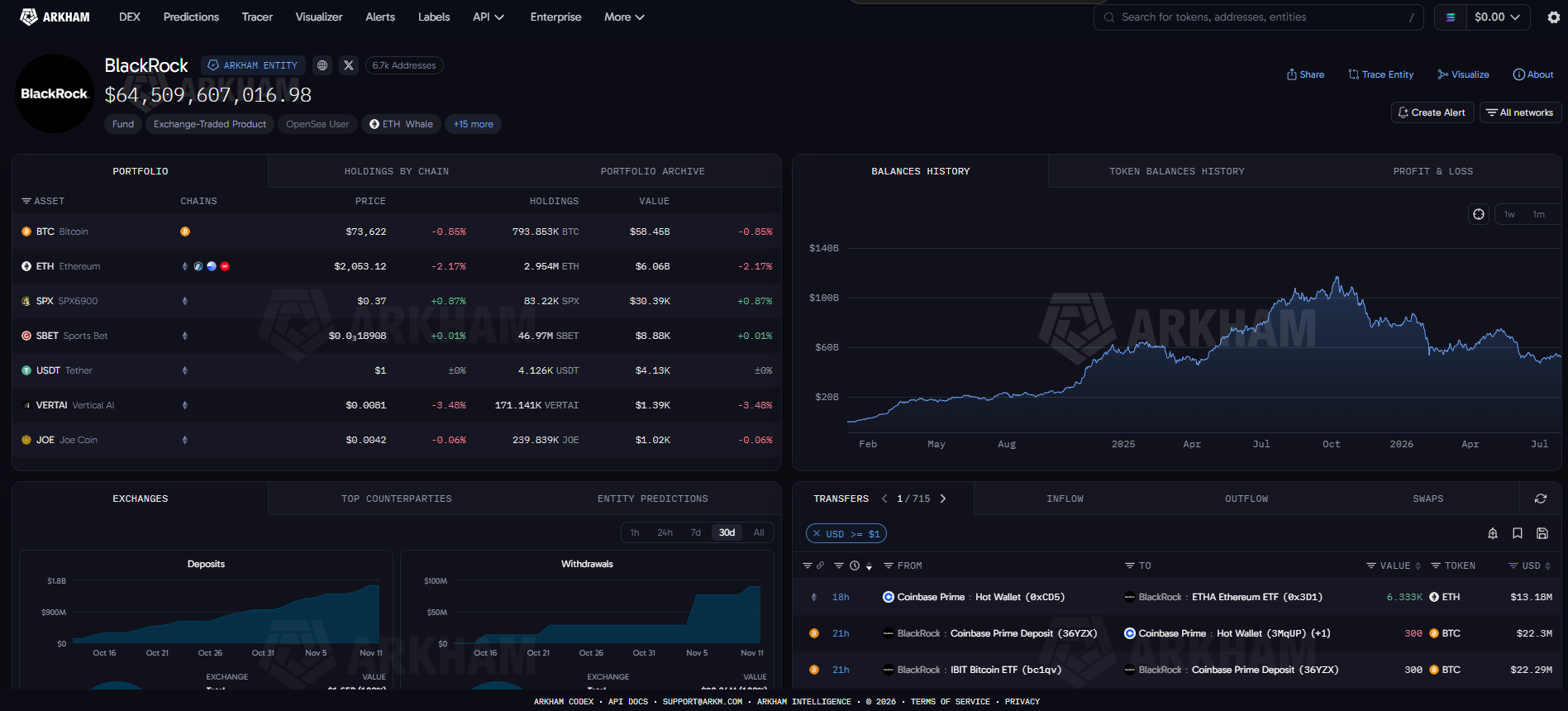
BlackRock entity on Arkham - Arkham
2. Read the transfer history: Under the entity’s transfers, transactions can be filtered by token, value, date, sender or recipient. For ETFs, look for transfers between the fund's wallets and its custodian or prime broker. A stream of coins arriving usually means new shares were created, and coins leaving usually means shares were redeemed.
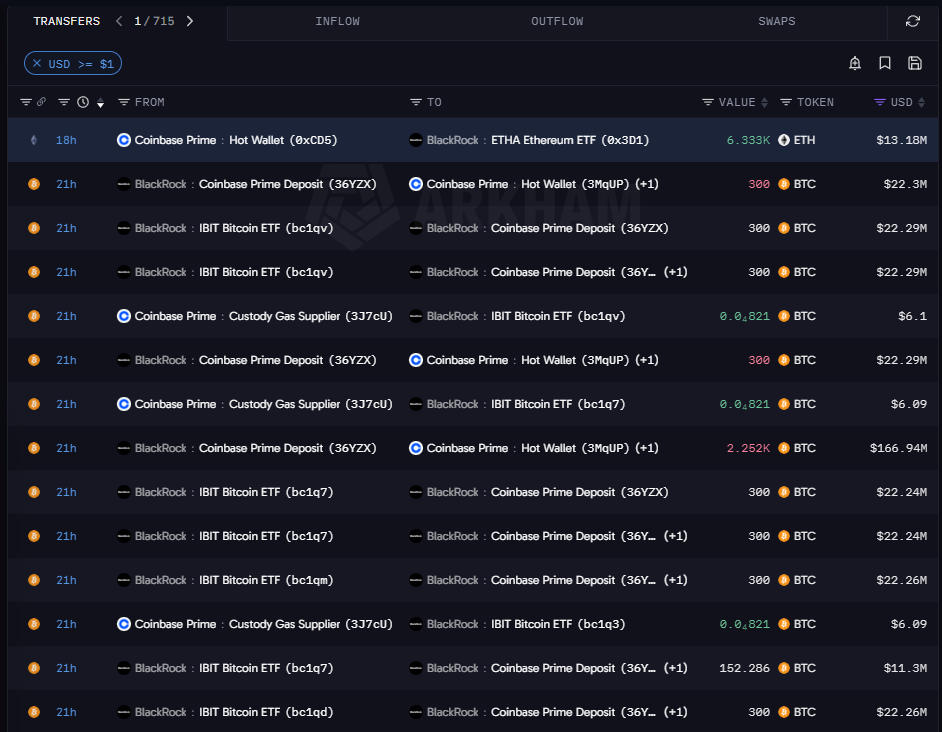
Transfers between BlackRock addresses and Coinbase Prime - Arkham
3. Set an alert: Create an alert on the entity or on a single wallet. Alerts can be filtered by counterparty, token, chains, and amounts. Arkham will notify you as soon as the criteria for the alert is hit.
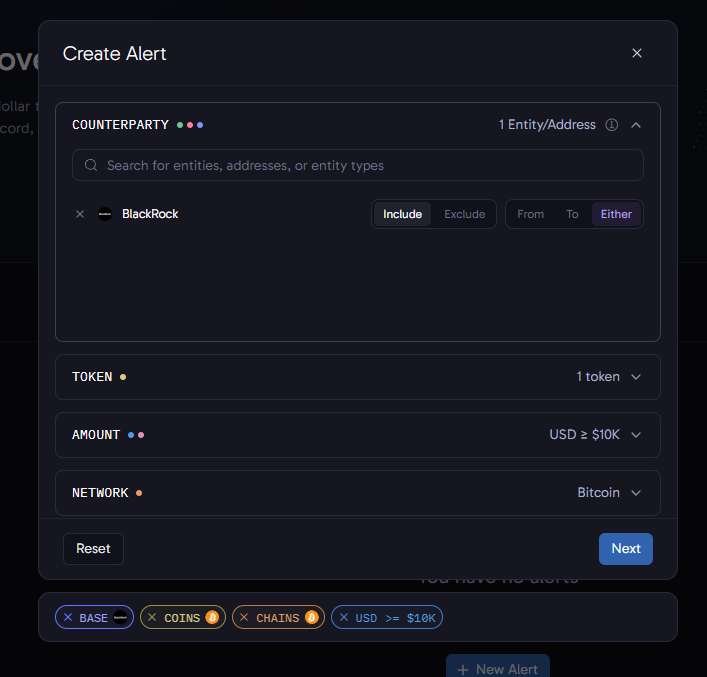
Setting an alert on BlackRock addresses for Bitcoin transfers above $10K - Arkham
Reported ETFs flows only tell you the net inflow or outflow, while the on-chain data shows when the coins actually moved and where they were eventually stored.
What Are Institutional Digital Asset Flows?
Institutional digital asset flows refer to the movement of cryptocurrencies that large, regulated holders buy, sell or move between wallets.
They can be tracked in two ways. The first and easiest way is through reported flows. For an ETF, these are creations and redemptions: an authorized participant, usually a large trading firm, hands the fund cash or coins in exchange for new shares, or returns shares to receive cash in return. Respective ETF issuers publish the net result after each trading day. For treasury companies, purchases and sales of cryptocurrencies are reported in their regulatory filings.
The second way is through monitoring on-chain movements. Every transfer is recorded on the blockchain and is public for all users to view. Think of reported flows as a bank statement listing the day's deposits and withdrawals at a bank, while the on-chain data is the security camera footage showing when the cash arrived and left the premises. Notably, for financial settlement in most markets, there is a T+1 delay, which means that reported flows often represent the prior trading days flows, while on-chain data shows flows as they occur. On-chain flows and report flows should tally on the numbers, although their timing may differ slightly.
Spot ETFs
The core value proposition of spot ETFs is the holding of actual coins backing each and every one of their shares, so every share created or redeemed eventually shows up as a transfer on-chain. U.S. spot Bitcoin ETFs launched in January 2024, and spot Ether ETFs followed later that year. BlackRock's iShares Bitcoin Trust (IBIT) is the largest, with its holdings reaching 793,853 BTC as of November 2026.
The live feed above shows BlackRock's labelled wallets on Arkham. According to IBIT's prospectus, the fund's Bitcoin is held by Coinbase Custody in accounts kept separate from other customers, with the private keys stored completely offline. Each fund therefore uses its own wallets, which also allows Arkham to track and label them accurately. Incoming coins tend to arrive in repeated, round amounts, with IBIT’s inflows usually sent in batches of 300 BTC each. ETF custody wallets mostly sit still. They take in coins in uniform batches when shares are created, and send them out when shares are redeemed.
Treasury Companies
A treasury company is a business that holds crypto as a core reserve asset, usually accumulating over time with money raised from investors.
The flow follows a set pattern. The company sells shares or other securities, uses the proceeds to purchase coins, and moves them into institutional custody. Strategy (formerly MicroStrategy) is the largest example. Its 8-K filing for November 2 to 8, 2026 reported 1,036 BTC bought for $81.9 million, all funded by sales of its common stock, which took its total holdings to 850,364 BTC. Strategy files these updates on almost every occasion that they make a purchase. However, they do not name the individual wallets which hold their Bitcoin.
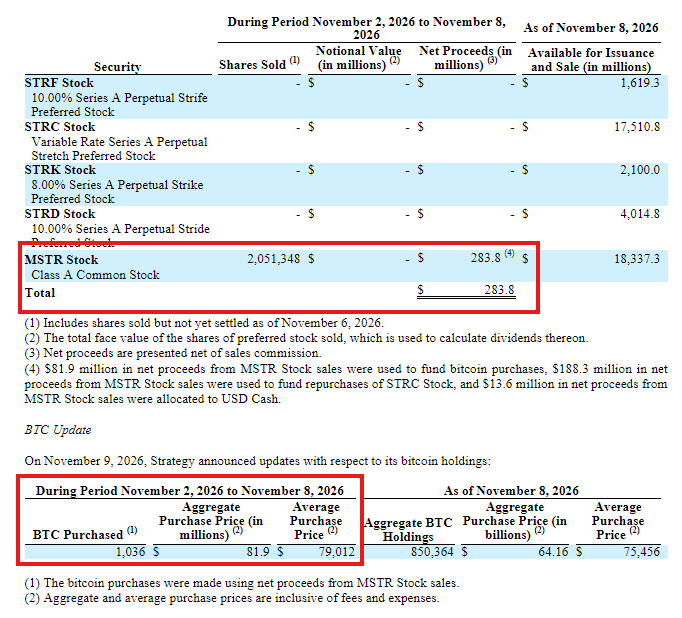
Strategy’s 8-K showing the amount raised and Bitcoin purchased - SEC Edgar
Nevertheless, in May 2025, Arkham attributed 507,000 BTC to Strategy, about 87.5% of what the company then reported holding. About 107,000 BTC of that total had been sent to Fidelity Custody, which pools client assets, hence Arkham does not show it under the Strategy entity.
For crypto treasury companies that accumulate ETH instead, staking adds an additional angle. BitMine Immersion Technologies, Inc. reported 6,070,092 ETH as of November 9, 2026, about 4.97% of the total ETH supply, with 5,227,037 ETH staked. Staked ETH moves into validator deposits on-chain, so a treasury's staking activity can be tracked as well as its purchases.
Custodians and Prime Brokers
Most institutional crypto passes through a small group of custodians and prime brokers, such as Coinbase Prime, Fidelity Digital Assets, Anchorage Digital and BitGo. A prime broker handles the trading, and a custodian holds the coins afterward, often in a secured, cold storage setup. Many firms offer both services to their clients.
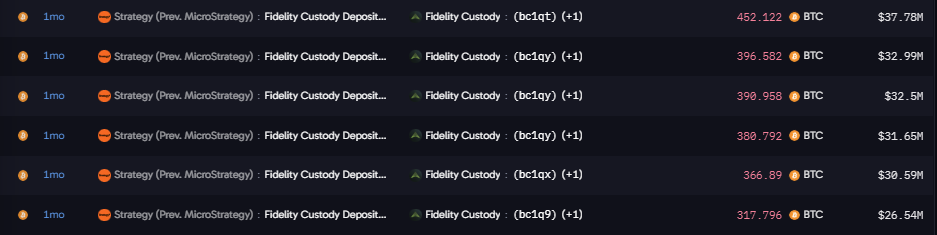
Bitcoin transfers from Strategy addresses to Fidelity Custody - Arkham
A custodian’s setup and how they manage the coins impacts how much an on-chain observer can see. IBIT's prospectus shows both setups side by side. Its main "Vault" balance sits in segregated accounts, but its "Trading" balance is an omnibus claim on the prime broker's pooled Bitcoin, with no specific coins assigned to the fund. Segregated wallets belong to one client and can be labelled while omnibus wallets combine several clients' coins together, and transfers between those clients can be settled on the custodian's own books without touching the chain. That is why Strategy's coins at Fidelity Custody drop out of view on Arkham, although on-chain data does still show transfers into Fidelity Custody’s addresses.
How to Read ETF Flows On-Chain
On-chain movements rarely match a day's reported flow to the hour or the coin. These discrepancies can be mostly attributed to three main factors.
Settlement timing: Issuers usually publish flows on the evening of the trading day. However, coins do not usually move on the same day. In the case of BlackRock’s IBIT, the coins are bought and credited to their Trading balance on Coinbase Prime, which does not show up as an on-chain transfer yet. These coins are only moved later based on the custodian’s schedule to their respective Vaults later on, resulting in a timing discrepancy.
Custodian batching: Custodians generally also move coins in set sizes rather than one transfer per order. Between BlackRock’s IBIT and their custodian, Coinbase Prime, transfers are often made in 300 BTC batches. That said, batching sizes should not create a discrepancy between reported and actual flows as over time, the flows should reconcile to the same figures.

BlackRock’s 300 BTC batch transfers - Arkham
Internal transfers: Coins sometimes move between a fund's own wallets, or between its Vault and Trading balances, with no change in shares. To the untrained eye, these may look like large flows but are simply operational practices.
The spot ETF mechanics are also changing over time. Until mid-2025, U.S. spot Bitcoin and Ether ETFs could create and redeem shares only for cash. On July 29, 2025, the SEC approved in-kind creations and redemptions, which let authorized participants deliver or receive the coins themselves.
Do Institutional Flows Move Crypto Prices?
Institutional flows and crypto prices are generally observed to move together, but research has not settled how much the flows drive prices and how much they simply follow them.
The studies so far point in both directions. In a 2025 paper in the Journal of Alternative Investments, Mieszko Mazur and Efstathios Polyzos found that net flows into spot Bitcoin ETFs strongly predicted Bitcoin price levels in the funds' first weeks of trading. They also found that rising prices led to unusual ETF trading volume, and that most price changes happened outside ETF trading hours. A separate study covering January 2024 to May 2025 further supports this, showing that ETF assets and the Bitcoin price stayed correlated over the long run. However, while it proves a link between the two, it does not clearly show whether price leads flows or whether flows are leading the asset’s price.
A key part of the difficulty is that institutional flows react to asset price as well. As the first study's volume finding suggests, a large inflow can be a response to a price move rather than its cause.
Conclusion
Institutional flows reach the public as daily tables and weekly filings, but the coins behind them move on-chain in real time. Most of the wallets involved are public, and many are already labelled by blockchain intelligence firms like Arkham. Reading the reports and the chain side by side shows how much an institution's position changed, and also when and how the coins actually moved.

0xKira
0xKira is a crypto writer with roots in venture capital, having previously worked at Spartan Labs. An active DeFi user for the past five years, he has spent the last three years writing for industry publications like CoinMarketCap, as well as for a variety of DeFi protocols. 0xKira is known for his in-depth Twitter threads about the latest crypto trends - follow him on Twitter @0xKira_
More from 0xKira