Guide ·
How Institutions Manage Crypto Compliance: A Practical Guide
How banks, funds and fintechs manage crypto compliance: AML program basics, counterparty due diligence, transaction screening, source-of-funds checks and monitoring
Summary
Institutional crypto compliance is the set of controls a bank, fund or fintech app uses to confirm that the crypto it handles is lawful, comes from clean sources, and can be explained to a regulator.
A crypto compliance program rests on the same pillars as any anti-money laundering program: internal controls, a compliance officer, staff training and independent testing, built on a risk assessment.
Three on-chain checks do most of the work: due diligence on counterparties, screening of individual transactions, and tracing the source of funds behind deposits.
On-chain data sits at the center because the blockchain records every transfer, so an institution can independently verify where funds came from instead of relying only on what a customer says.
How Institutions Run Crypto Compliance in Arkham
The three workflows below cover the core on-chain checks required by institutions running crypto compliance programs on Arkham.
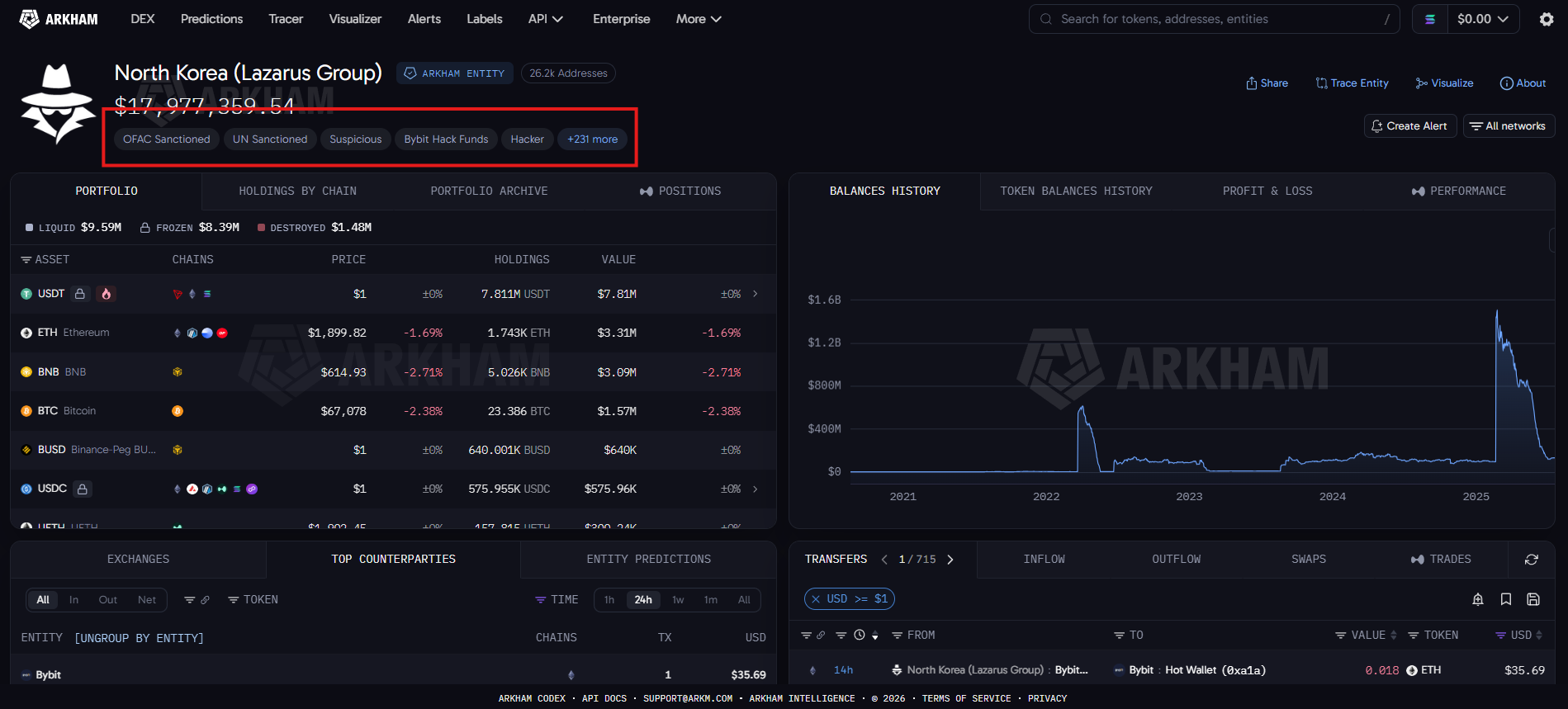
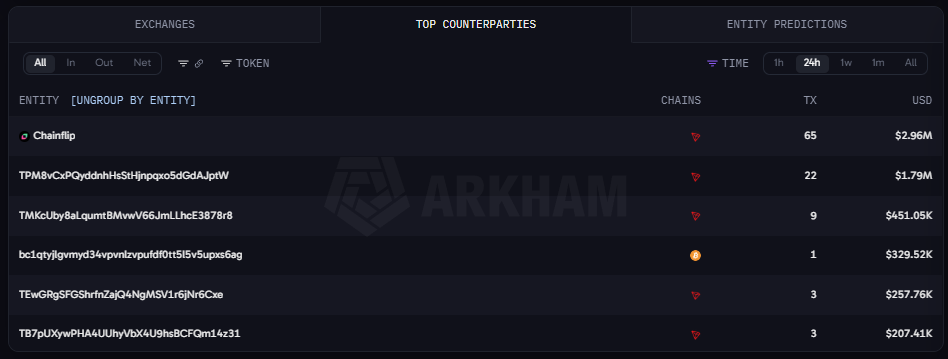
1. Screen a counterparty entity: Search for the exchange, OTC desk or fund you plan to deal with and open its entity page. Check the tags first, since Arkham directly flags known sanctioned or banned addresses there. Then open the Top Counterparties tab to see which services the entity sends funds to and receives funds from. Counterparties can provide additional information on exposure to other sanctioned addresses which institutions should be wary of.
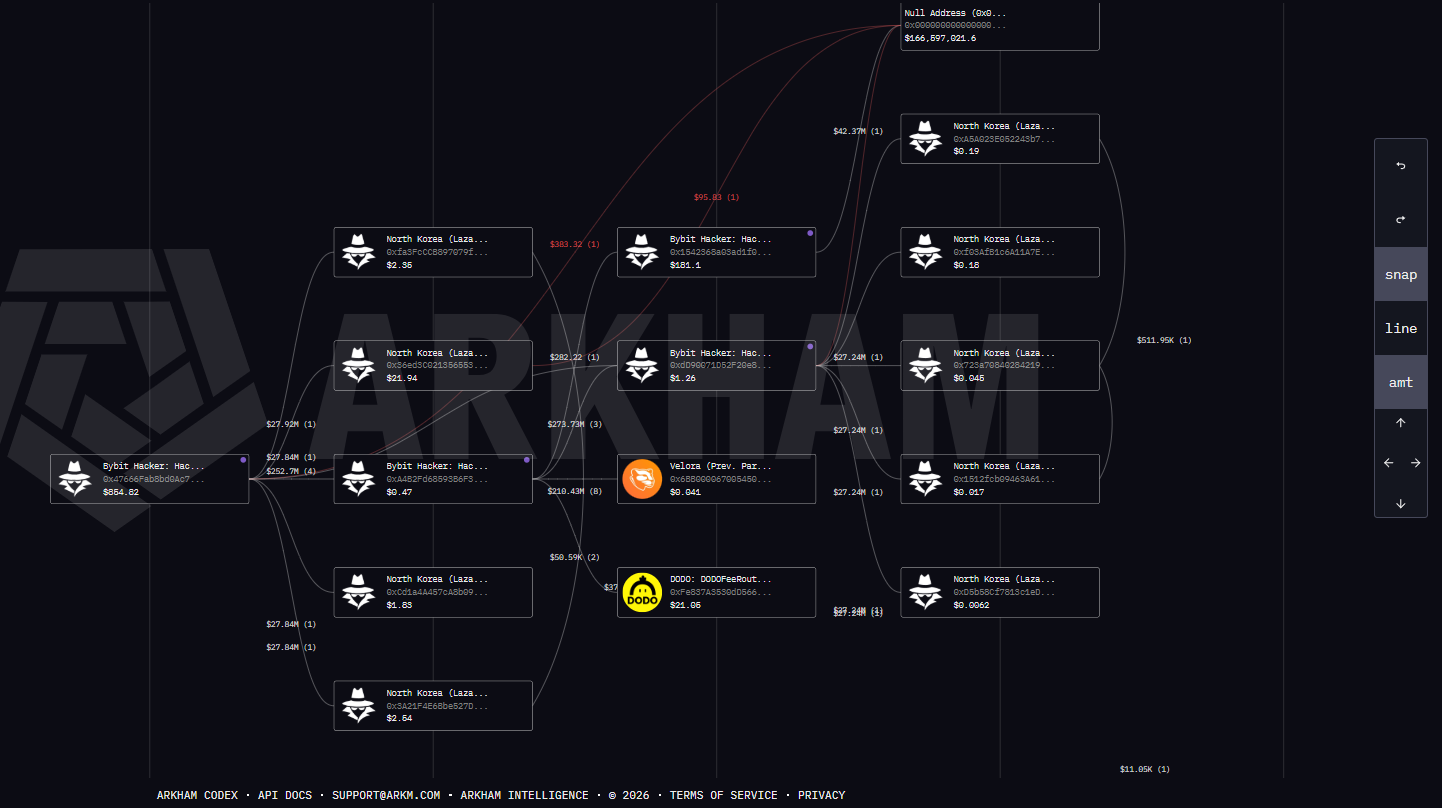
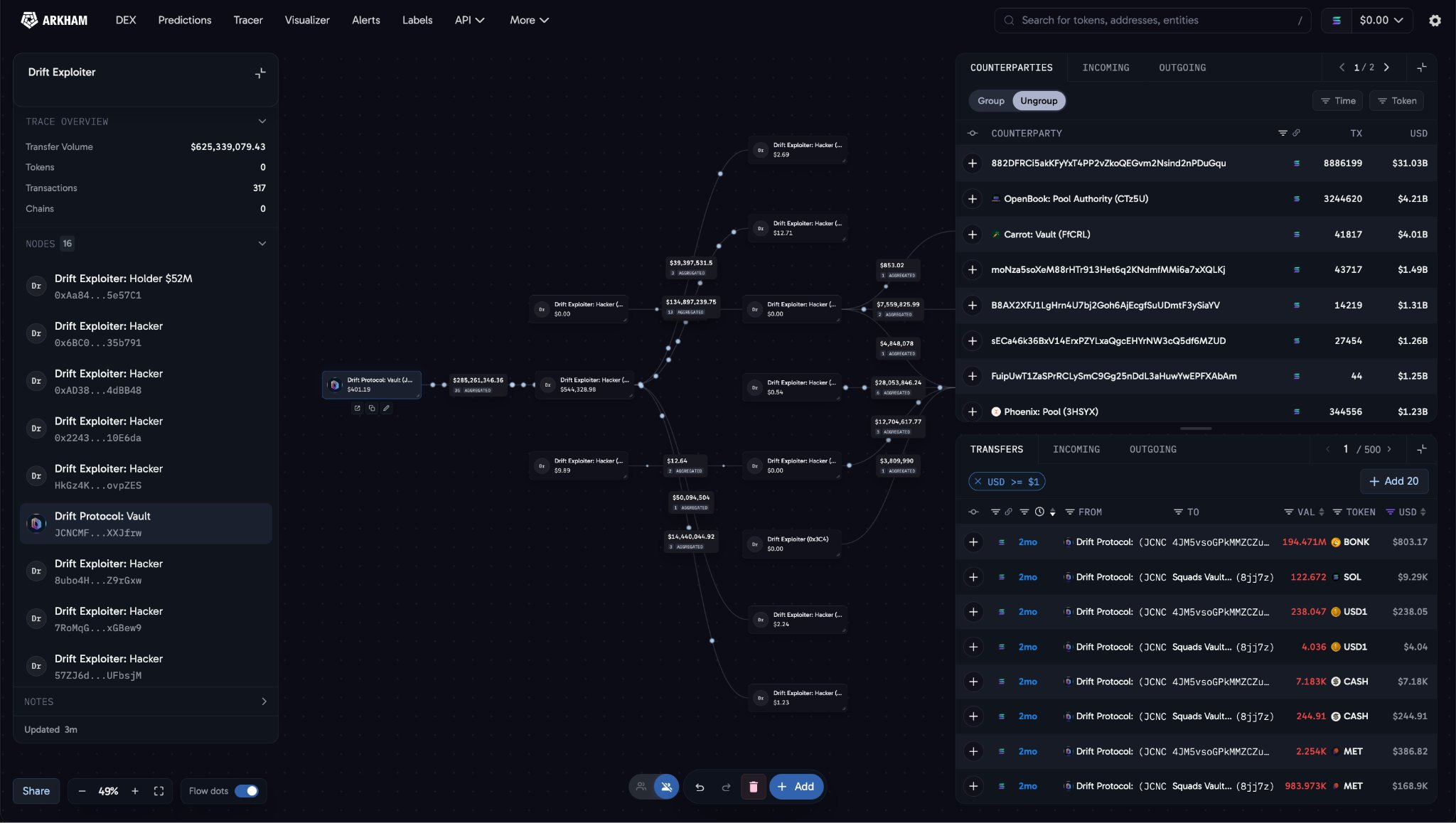
2. Trace a deposit's source of funds. Paste the sending address of a deposit into Arkham and open its inflows. Follow each incoming transfer back one hop at a time until you reach a labelled entity, such as an exchange, a fund or a flagged service. Arkham’s Tracer can map the path across several hops as a single view, making it easy to track funds across multiple transfers.
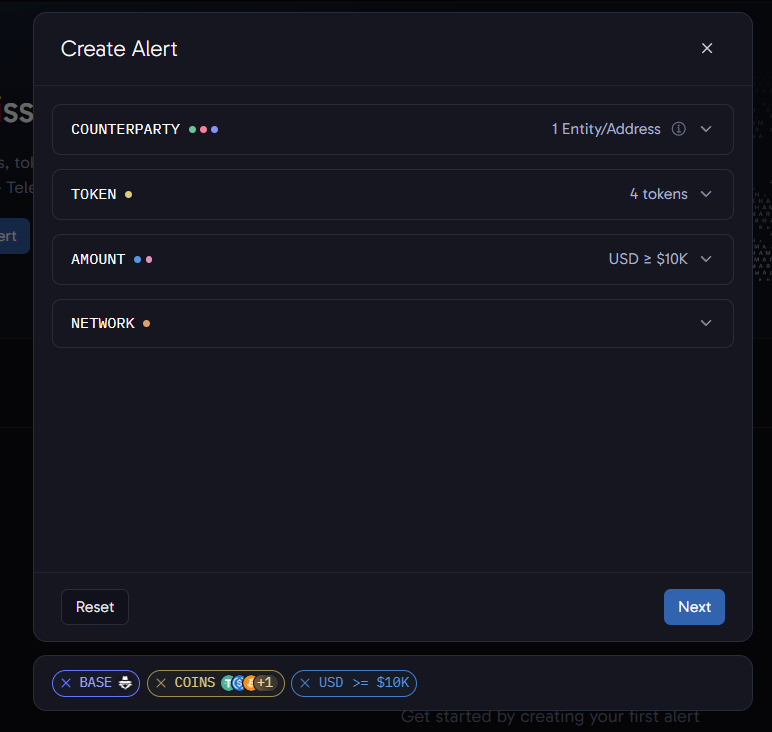
3. Set alerts on client and counterparty wallets. Create an alert on any address or entity you need to monitor. Arkham notifies you when funds move, so a large outflow or a new counterparty can be reviewed the same day. These alerts can be further filtered by tokens, amounts, and network for additional granularity.
At the core of it, these three workflows boil down to the same two questions: who is behind this address, and where did its funds come from?
What Is Crypto Compliance for Institutions?
Crypto compliance for institutions means applying anti-money laundering, sanctions and customer due diligence rules to every point where a firm touches digital assets.
It applies to banks that hold crypto for clients, asset managers running crypto funds, fintech apps that let users buy or send coins, payment firms that settle in stablecoins, and specialist custodians. A simple way to view it is that the rules are the same as those that these financial institutions already follow for wire transfers. The addition of crypto only changes the procedures and checks, but the underlying purpose remains the same.
In the U.S., several agencies share the work. Financial Crimes Enforcement Network (FinCEN), under the U.S. Treasury, writes and enforces the Bank Secrecy Act rules, and its 2019 guidance confirmed that crypto exchanges and hosted wallet providers count as money transmitters. The U.S. Treasury’s Office of Foreign Assets Control (OFAC) administers sanctions. Bank supervisors such as the Office of the Comptroller of the Currency (OCC) oversee how banks run crypto activities. In March 2025, the OCC confirmed that crypto custody and certain stablecoin activities are permissible for the banks it supervises, without prior sign-off. In the EU, national authorities license firms under MiCA, and in the UK the FCA oversees crypto firms' anti-money laundering controls.
What Does a Crypto AML Program Need?
A crypto AML program needs the same building blocks as any other compliance program: written controls, a named compliance officer, ongoing training and independent testing, centred around a regularly updated money-laundering/terrorist financing risk assessment of the firm.
The first four are the long-standing Bank Secrecy Act requirements. Banks, broker-dealers and other covered institutions also have a fifth: customer due diligence, which since 2018 has required them to identify the beneficial owners of business customers and keep monitoring client relationships on an ongoing basis.
A FinCEN proposal issued on April 7, 2026 would require every covered institution to document its money laundering and terrorist financing risks and update the assessment when those risks change. This proposal also mandates the AML/CFT officer to be based in the U.S. At the time of writing, it had not been finalized.
Pillar | How Crypto Influences It |
Risk assessment |
|
Internal controls and policies |
|
Compliance officer |
|
Training |
|
Independent testing |
|
How to Do Due Diligence on a Crypto Counterparty
Counterparty due diligence starts with a paper check, much like in traditional finance, but adds on an on-chain one to complete it.
The checks begin with licensing and registration. Confirm that the exchange, broker or custodian is allowed to operate where it serves you. Public registers make this check simple:
U.S.: FinCEN's MSB Registrant Search lists registered money services businesses. It updates weekly and once a year FinCEN removes firms that fail to renew, so a missing name is worth a follow-up question.
EU: ESMA's interim MiCA register lists authorized crypto-asset service providers. It also lists non-compliant entities, which makes it useful for spotting firms to avoid.
UK: the FCA's public register shows which firms it has registered or authorized.
It should be noted that while registration shows that a firm exists in a regulator's records, it does not show how well that firm screens its own customers.
The on-chain check involves checking the counterparty's on-chain history. Open the counterparty's entity or address page on Arkham and review where its funds have gone and come from. Repeated transfers with sanctioned services, mixers or unlicensed exchanges suggest that its controls let risky funds through, despite what its paperwork may say.
How Do Banks Screen Crypto Transactions?
Banks screen both outgoing withdrawals before they are sent, and incoming deposits once they arrive.
Before a transfer, the bank checks the destination address. Is it on a sanctions list? Does it belong to a known service, and if so, which one? A withdrawal to an address linked to a sanctioned exchange should be stopped before it is signed, because a confirmed transfer cannot be pulled back.
After a transfer, the bank screens the incoming deposit and the address it came from. Crypto cannot be refused at the door the way a wire can. The coins have already landed by the time anyone looks, so the question becomes whether to credit, freeze or report them.
In crypto, firms are concerned with both direct and indirect exposure when it comes to funds passing through their systems. Direct exposure means that the deposit came straight from a sanctioned or flagged address. On the other hand, indirect exposure means it passed through one or more wallets in between. Screening tools typically score both, and each institution decides how many hops back it treats as relevant. Exact-match checks against the sanctions list have two gaps. They miss indirect exposure, and OFAC itself says its address listings are ‘not likely to be exhaustive’, yet it still expects firms to block funds tied to a sanctioned person whether or not the address is listed.
For a more detailed look at the mechanics of each check, see our guides to wallet screening and the OFAC sanctions list. Crypto Sanctions 101 breaks down how crypto addresses end up on those lists in the first place.
How to Check the Source of Funds for Crypto Deposits
A source-of-funds check asks a simple question: before these coins reached the client, where were they?
Trace the deposit backward, starting with the deposit transaction and open the address that sent it. Look at that address's own inflows, then repeat for each earlier wallet. The trace ends when you reach a labelled entity, such as a regulated exchange where the client says they bought the coins. If the trail matches the client's story, the check is usually done. If it runs through unlabelled wallets for many hops, keep going or ask the client for more.
Some commonly flagged transactions include:
Mixers: Funds that are received from a service like Tornado Cash have had their on-chain trail deliberately broken. While there are legitimate uses for mixers, the majority of financial institutions still tend to flag such behavior. Our Tornado Cash explainer dives deeper into mixers work.
Sanctioned entities: Any hop through a listed address or a sanctioned service, such as sanctioned exchanges, known hacker groups, or criminal organizations.
High-risk or unlicensed exchanges: Platforms that skip customer checks, or that appear on a regulator's list of non-compliant entities tend to get flagged as well. These exchanges need not be sanctioned yet, but are often used for illicit activity.
Rapid hops through fresh wallets: Coins passed quickly through newly created addresses, often in shrinking amounts, a pattern known as a peel chain.
Chain hops: Funds bridged or swapped onto another blockchain shortly before the deposit.
These findings should be documented as they are uncovered. Record the deposit's transaction hash, each address and hash along the path, the entities identified along the trace, any red flags and the decision you reached, with the reasoning and date. A reviewer or examiner should be able to retrace the check from the file alone. For a deeper look at how investigators build these trails, see our guide to blockchain forensics.
How Do Institutions Monitor Crypto Activity on an Ongoing Basis?
Institutions monitor crypto activity by running every client transaction through rules and alerts, then reviewing and escalating what the system flags.
Onboarding checks show what a client looked like on day one. Monitoring catches what changes afterward, such as a wallet that starts receiving funds from a flagged service, a sudden jump in volume, or a counterparty that is sanctioned months after the relationship began. The usual cycle has four steps:
Monitor: Rules flag transactions by exposure, size, speed or pattern.
Alert: Flagged activity lands in a queue for an analyst.
Escalate: The analyst reviews the trail and passes on serious cases to the compliance officer.
Report: Where the activity looks suspicious, the institution files a suspicious activity report with its financial intelligence unit, which in the U.S. is FinCEN.
Our guide to transaction monitoring covers rule design and alert triage in detail.
For teams that want to build this into their own systems, Arkham's API documentation includes a worked transaction monitoring and KYC example for brokers. Arkham also offers address risk scores from 0 to 100, with a written briefing for each, as a paid add-on to the Arkham API.
Which Crypto Regulations Do Institutions Need to Know?
The rules below set the baseline for most institutions dealing in crypto in the U.S., EU and UK.
Rule | What it means for institutions |
U.S.: Bank Secrecy Act (FinCEN) | According to FinCEN’s 2019 guidance, crypto exchangers and hosted wallet providers are money transmitters, with AML program and suspicious activity reporting duties. |
U.S.: GENIUS Act | Treats permitted payment stablecoin issuers as financial institutions under the Bank Secrecy Act, with AML, sanctions and customer identification duties. The Act was signed in July 2025 and takes effect on January 18, 2027. |
U.S.: OFAC sanctions | Dealings with listed persons and addresses are prohibited, and any sanctioned funds received must be blocked and reported. Explore OFAC sanctions in greater detail with our guide. |
Travel Rule | Firms must send sender and recipient details with transfers. In the U.S. this applies to transfers of $3,000 or more; the EU's Transfer of Funds Regulation has applied to crypto transfers since December 30, 2024. Read more about the Travel Rule in our compliance guide. |
EU: MiCA | Crypto service providers need MiCA authorization; the transition period for existing firms ended on July 1, 2026. |
EU: AML package | The new Anti-Money Laundering Regulation applies from July 10, 2027 and treats all crypto service providers as obliged entities. |
UK: FCA | The FCA currently oversees crypto firms' AML controls and financial promotions; a full authorization regime starts October 25, 2027, with existing firms must apply by February 28, 2027. |
Conclusion
Institutional crypto compliance follows the same logic as traditional AML: know your counterparties, screen what moves and report what looks wrong. What changes is the evidence. In crypto, the record of where funds came from sits on a public ledger, and a compliance team has to read it.

0xKira
0xKira is a crypto writer with roots in venture capital, having previously worked at Spartan Labs. An active DeFi user for the past five years, he has spent the last three years writing for industry publications like CoinMarketCap, as well as for a variety of DeFi protocols. 0xKira is known for his in-depth Twitter threads about the latest crypto trends - follow him on Twitter @0xKira_
More from 0xKira