Research ·
Crypto AML Software: How to Choose the Right Tool
What crypto AML software does, the capabilities that matter, how to compare risk scoring and attribution, and the questions to ask before you buy.
Summary
Crypto AML software is a tool that reads blockchain activity, works out who is behind the wallets involved, and flags transfers linked to crime or sanctions so that a compliance team can act on them.
The core capabilities include wallet screening, transaction monitoring, sanctions screening, investigation and tracing, and Travel Rule support.
Strong tools stand apart on attribution coverage, risk scores broken down by category, exposure measured across several hops, fast sanctions updates and a clear audit trail.
Attribution quality decides everything else, because a tool can only screen, score or trace the wallets it has identified.
How Arkham Handles Crypto AML
The walkthrough below applies this guide's evaluation criteria to Arkham. Arkham's data covers 8 billion address tags and 1.2 million entity profiles, with each check below built on those labels.
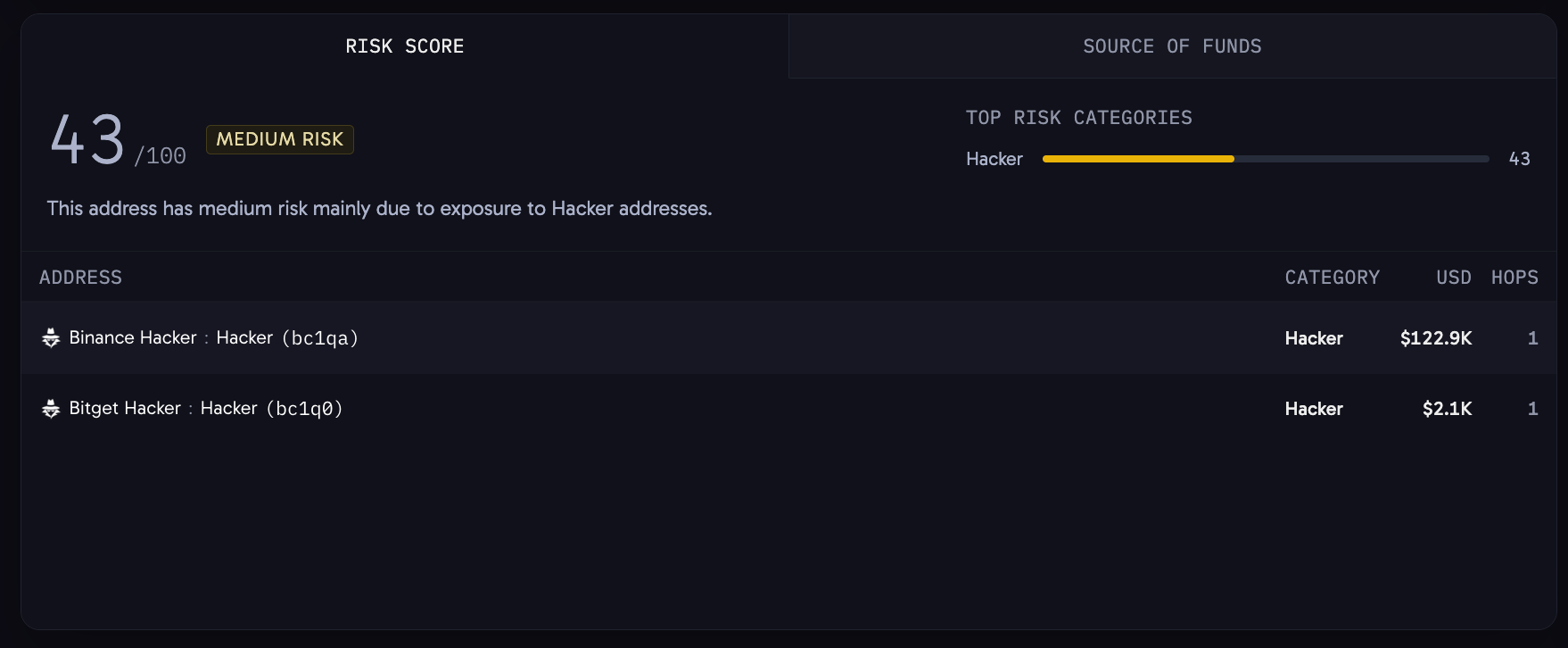
Wallet screening with category-level risk scores: Arkham's Risk Scores rate any address or entity from 0 to 100 for exposure to illicit activity. Each score comes with a Risk Briefing that explains the reasoning, lists the risk categories assigned and names the risky addresses it is connected to. Risk Scores are a paid add-on to an Arkham API subscription. Risk Scores are included in Arkham Enterprise.
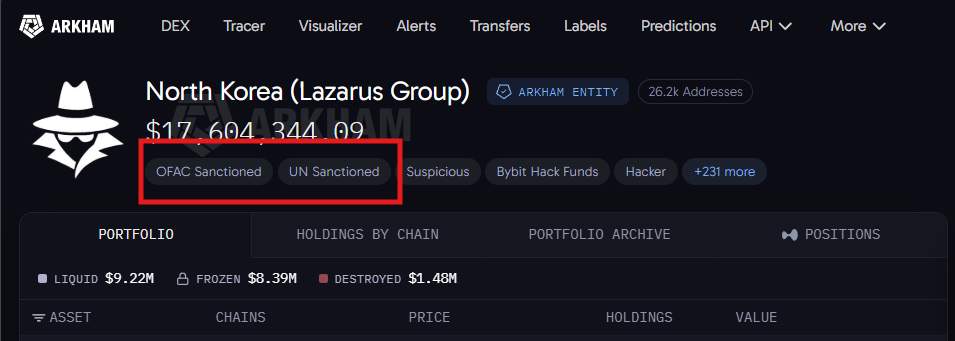
Counterparty due diligence on an entity: Open the counterparty's entity page and check its tags, where Arkham flags sanctioned or banned addresses. The Top Counterparties tab then shows which services the entity has sent funds to and received funds from.
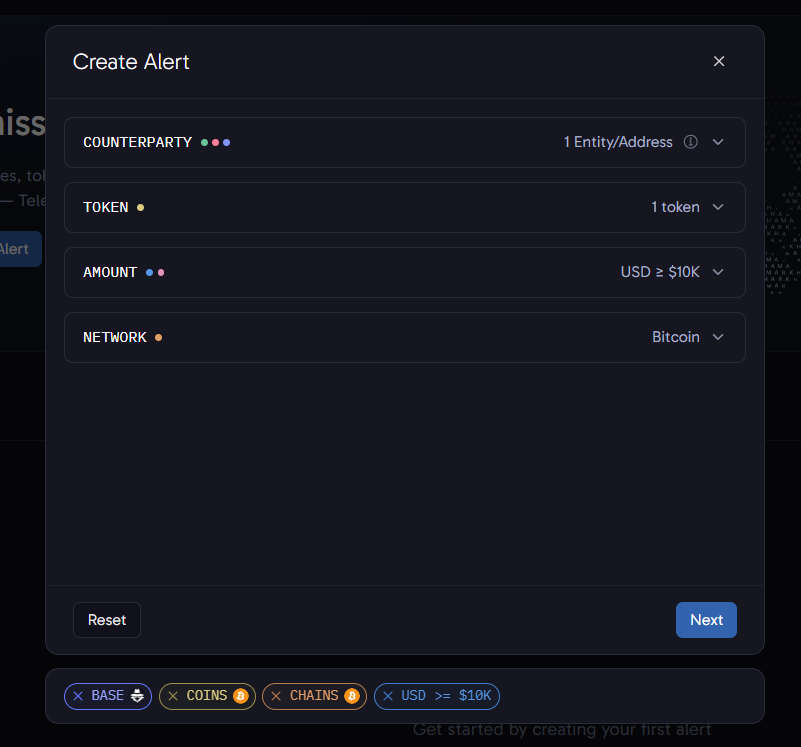
Transaction monitoring alerts: Set an alert on a client wallet, a counterparty or a flagged entity with Arkham’s alerts. Filter alerts down by addresses, tokens, chains, and value to reduce noise. Arkham notifies you when funds move, so a new inflow from a risky source reaches an analyst quickly.
Build With Arkham API
Teams that already run a compliance stack can plug Arkham's data straight into it. The Arkham API returns entity attribution, transfer histories and, with the add-on, Risk Scores, so deposits can be screened automatically before they are credited. Arkham's API documentation also includes a worked transaction monitoring and KYC example for brokers.
All three checks rest on the same foundation. A risk score, a counterparty review or an alert can only be as good as the number of addresses the tool has actually attributed. The larger the number of attributed addresses, the more comprehensive the coverage.
What Is Crypto AML Software?
Crypto AML software is a system that turns raw blockchain records into risk information that a compliance team can act on.
It reads transfers between addresses, matches those addresses to known entities such as exchanges, mixers or sanctioned groups, and scores how closely a client's funds connect to illicit activity. It then flags what needs review and keeps a record of each decision.
Traditional bank AML systems typically are unable to do this on their own. They are built for account data: names, account numbers and wire messages that clearly label the senders and recipients behind a transaction. A blockchain transfer carries none of that. It shows only that one string of characters sent value to another. A bank system can see that a client bought bitcoin from an exchange. It cannot see where those coins went next, or where they came from before. Crypto AML software fills that gap by putting names to the addresses first.
What Crypto AML Software Needs to Do
Any tool on a shortlist should cover five jobs. How these fit into a wider program is covered in our guide on how institutions manage crypto compliance.
Wallet screening: Checks an address before you send to it or accept funds from it. See our wallet screening guide for more details.
Transaction monitoring (KYT): Watches client activity over time and flags transfers that cross your risk rules. Our transaction monitoring guide dives deeper into this topic.
Sanctions screening: Matches addresses and entities against government-issued sanction lists such as the OFAC sanctions list.
Investigation and tracing: Follows funds across wallets and chains when an alert flags a specific address or transaction that needs additional attention. See blockchain forensics explained and our guide to on-chain analysis.
Travel Rule support: Exchanges sender and recipient details with other providers when funds move between them. The Travel Rule and other key crypto compliance rules are covered further in our guide to crypto compliance.
How to Evaluate Crypto AML Software
Crypto AML software should be evaluated based on how much of the blockchain it can identify, how clearly it explains risk, and how well it fits the way your team already works.
Criterion | Why it matters | How to test it |
Attribution coverage | Every other feature depends on it. An unlabelled wallet looks clean to every check. | Ask for entity and address counts by chain, and look up known wallets such as exchanges, sanctioned entities and mixer services. |
Risk scoring by category | Risk scoring needs a breakdown by exposure category for an appropriate response. Sanctions exposure and gambling exposure call for very different responses. | Check that each score breaks down into named categories with the respective reasoning clearly shown. |
Indirect exposure across hops | Illicit funds usually pass through one or more wallets before reaching you. | Ask how many hops back the tool looks, and how exposure is weighted at each hop. |
Sanctions update speed | OFAC's address lists are not likely to be exhaustive, and new designations need to reach your screening fast. | Ask how long it takes from an OFAC listing to be added as a live flag, and whether the tool labels related wallets beyond the listed ones. |
Alerting and case management | Analysts need to review, escalate and close alerts in one place. | Run a sample alert from trigger to closed case. |
API and integrations | Screening has to happen inside your deposit and withdrawal flow, not in a separate tab. | Check the API documentation, rate limits and real-time options. |
Audit trail | Examiners and auditors will ask why each decision was made. | Confirm that every check, score and analyst note is properly logged with a date. |
A Worked Example
Taking a hypothetical example where a client deposits 5 BTC from a wallet with no label of its own.
Tool A checks the sending address against the sanctions list, finds no match and scores the deposit as low risk.
Tool B traces the funds back two hops. It finds that most of the coins came from a wallet it attributes to a sanctioned exchange, and it flags the deposit under its sanctions category with the path shown.
Both tools have "sanctions screening" on their feature list, but only Tool B caught the exposure, because it traced the funds back and was able to identify the wallet two hops back. Some sanctioned groups rotate wallets precisely to beat exact-match checks. The DOJ alleges that the Russian exchange Garantex changed its operational wallets daily to avoid being blocked by U.S. exchanges.
Run a Side-by-Side Trial
A demo shows a vendor's best case, but a trial on your own data shows how it handles yours. Before making a decision, run each shortlisted tool against the same set of addresses:
Known bad wallets: Pick addresses your team has already linked to scams, sanctioned entities or mixers. Count how many each tool flags, and how many hops back it finds the link.
Known clean wallets: Add addresses from regulated exchanges and long-standing clients. This check catches false positives, and too many flags here means analysts will spend their days clearing false alarms.
Recent designations: Include addresses OFAC listed in the past few months, and see which tools already flag them and the wallets around them.
Score the results against the criteria in the table above, so you can make an objective decision based on the evidence of your trials.
Key Questions to Ask a Vendor
The right questions force a vendor to show its data rather than its feature list.
How many entities and addresses have you labelled, and on which chains?
How do you attribute a wallet, and how do you correct a label that turns out to be wrong?
How long does it take for a new OFAC designation to appear in screening results?
How is indirect exposure calculated, and how many hops back does it go?
Does each risk score break down by category, with the reasoning shown?
Can we test the tool on wallets we have already investigated ourselves?
What does the API return, and how fast does it respond inside a live deposit flow?
What does the audit log record for each check and each analyst decision?
Build vs Buy
Building crypto AML tooling in-house usually stalls at attribution, not at data collection.
The raw data is the easy part. Blockchains are public, and a team can run its own nodes or pull transaction data from an existing provider at modest cost. What that data lacks is names. Turning billions of addresses into known entities takes years of work: clustering wallets, matching them to exchanges and services, and keeping labels current as wallets change hands. Arkham, for example, builds its labels through a combination of AI, in-house investigators and community research.
An in-house build therefore tends to produce a capable tracing engine with very few labels. It can follow coins perfectly well but cannot say whose wallets they reached. For most teams, the practical middle path is to buy the attribution and build around it, using a vendor's API inside their own monitoring and case management systems.
Conclusion
On a feature list, most crypto AML software look alike. The real difference is how much of the blockchain each one can identify. A tool that can name the wallets two or three hops back will catch exposure that a simple list check is unable to catch.

0xKira
0xKira is a crypto writer with roots in venture capital, having previously worked at Spartan Labs. An active DeFi user for the past five years, he has spent the last three years writing for industry publications like CoinMarketCap, as well as for a variety of DeFi protocols. 0xKira is known for his in-depth Twitter threads about the latest crypto trends - follow him on Twitter @0xKira_
More from 0xKira