Guide ·
Blockchain Intelligence API | Data Retrieval Dashboards Guide
Arkham API Dashboards are ready-made blockchain data and intelligence dashboards that speed up data retrieval and run directly on your API key. Here's how they work and what you can track
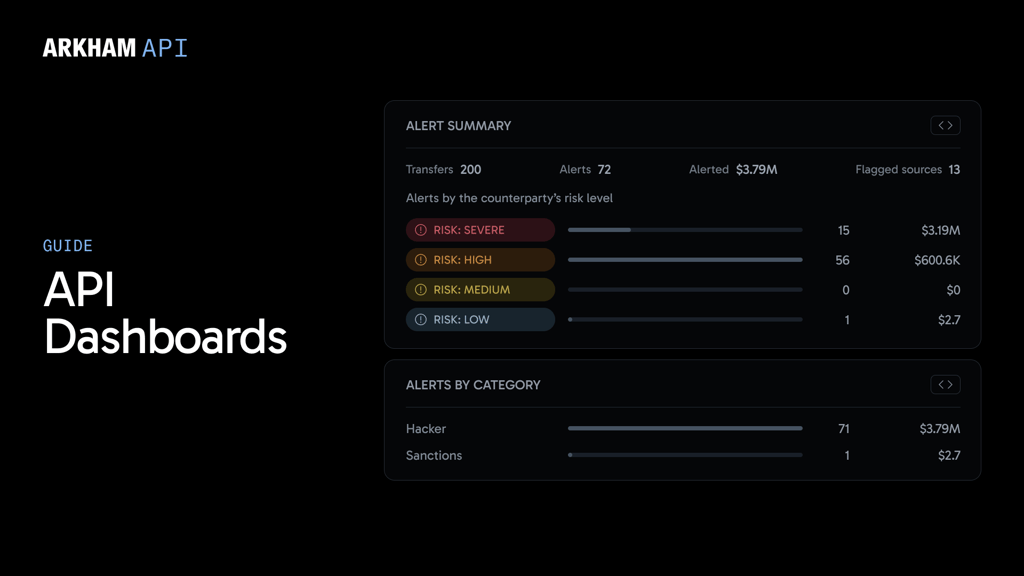
The Arkham API gives developers and businesses direct access to Arkham’s blockchain intelligence and enriched data - including the largest database of tags and labels in the industry. Institutions (businesses and government agencies) use the API to pull real-time on-chain data into their own systems, or into an AI tool.
Now, Arkham API users can use a purpose-built interface right on the Arkham website that enables fast and reliable data retrieval without any integration project.
Click here for our API Dashboards.
API Dashboards remove that step. They are ready-made monitoring and due diligence dashboards that run directly on your API key. Paste your key, pick an entity or an address, and press Run.
No implementation project. No lengthy onboarding. If you have an API key, you can get started right now. Our API Dashboards are pre-built around specific monitoring jobs, which we will discuss in more detail below.
How Do API Dashboards Work?
Each dashboard makes the API calls for you and shows you exactly what comes back. Choose an entity or address, set your time window, and decide how many wallets to focus on. Depending on the dashboard, you can also filter by token, date or portfolio size. Calls are billed at normal API prices, and you see the maximum credit cost before you press Run.
The Dashboards
We’ve built five dashboards so far.
Inflow & Outflow Monitoring shows what's moving in and out of exchanges. The direction of flow from exchanges is often an early indicator of where price pressure is coming from.
Portfolio Monitoring tracks holdings and balances across the entities and addresses that matter to you. Our dashboard makes this a quick and intuitive process.
Competitor Analysis reveals how other firms, your competitors, are positioning on-chain. The Arkham API is best-in-class for this, because of our de-anonymized database of entities.
Counterparty Due Diligence shows who a firm moves money with, and whether any of it traces back to a flagged source.
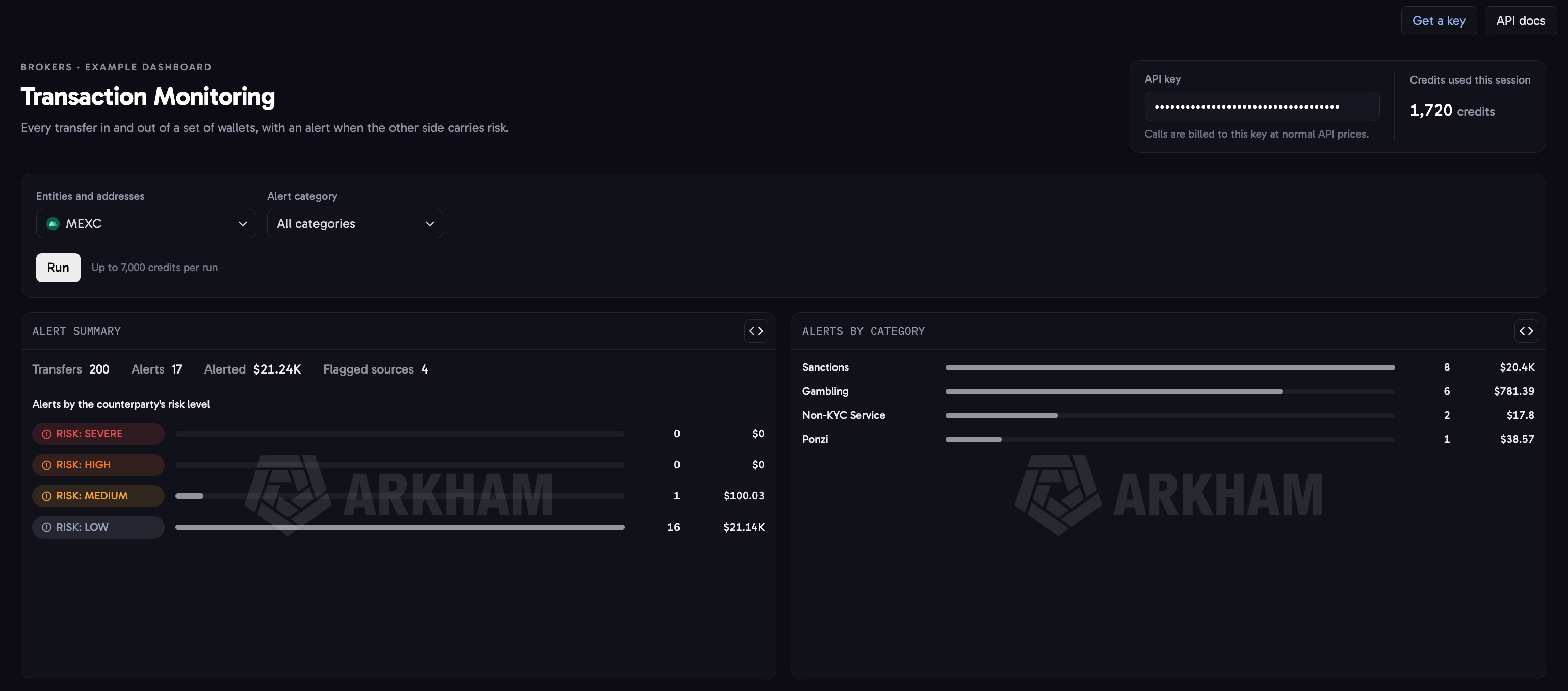
The fifth, Transaction Monitoring, is built for exchanges, brokers, funds and the compliance teams behind them. We go into detail on it below.
The Transaction Monitoring Dashboard
Transaction Monitoring is enterprise-grade Know Your Transaction (KYT) screening that runs in your browser on your own API key. You already know which addresses your organization owns, and which ones engage with your organization.
This dashboard shows you exactly who they are transacting with, in real time.
It watches any set of wallets, reads the latest transfers in and out, and runs every counterparty through Arkham's risk scoring. When funds trace back to a flagged source, you get an alert.
1. Choose What to Monitor
Search for entities or addresses, or paste in a list of wallets. You can monitor an exchange, a fund, your own deposit addresses, or any mix of them. Then pick the risk categories you care about from Arkham's tagging database, including sanctions, hackers, ransomware, darkweb markets, mixers, scams, token blacklists and non-KYC services. You can change categories at any time, and the dashboard updates without re-running.
2. Read the Feed
Every transfer is listed with a counterparty risk score, and the Alerts tab isolates the flagged rows. The top cards show your total alerts, the value they moved, and a breakdown by severity and category. The feed keeps checking for new transfers and screens each new counterparty as it arrives.
3. Investigate Any Alert
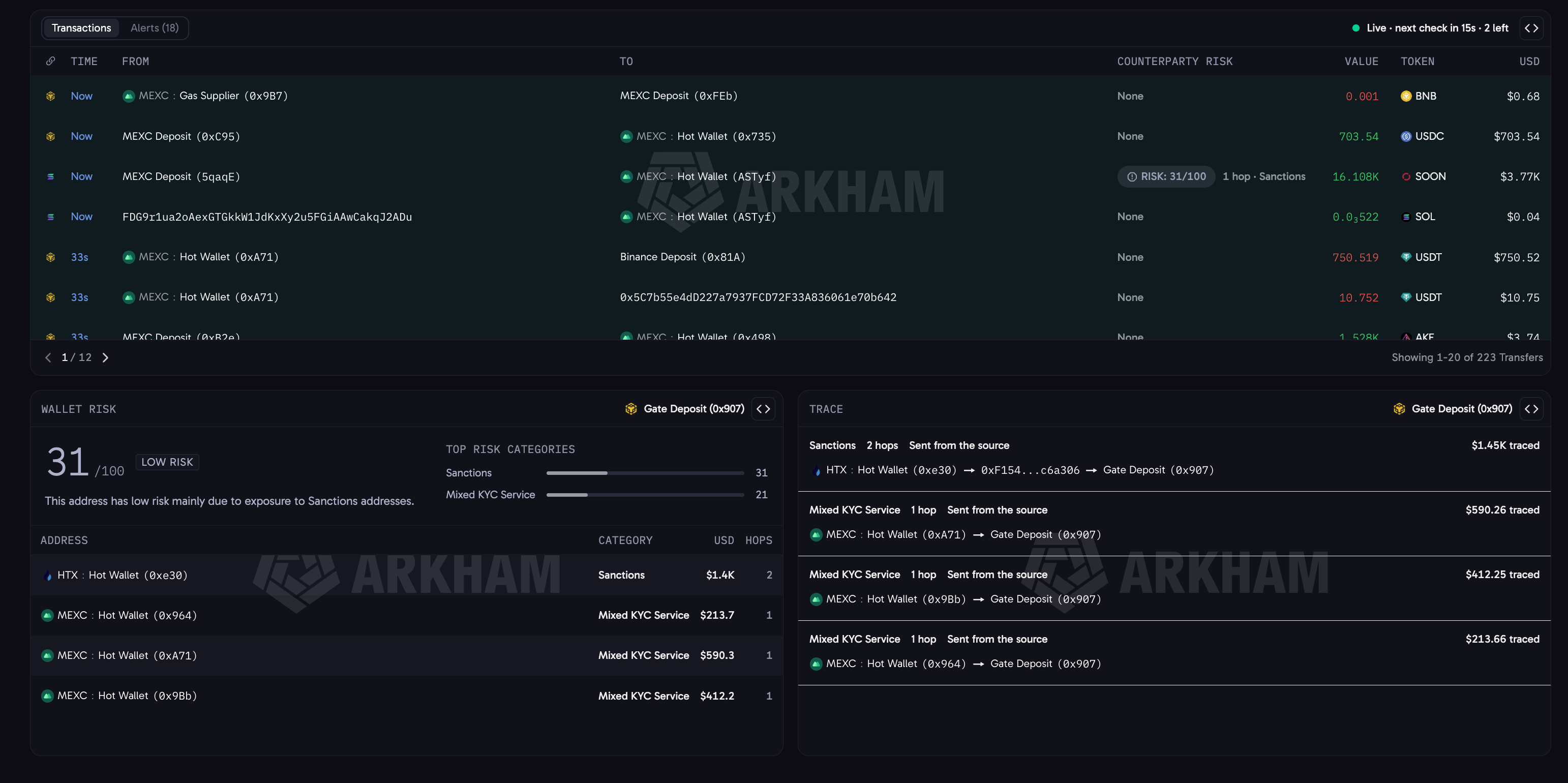
Click a transfer to see the counterparty's risk level and the flagged sources behind it. From there, follow the trace hop by hop until you find what you are looking for..
4. Build It Into Your Own Systems
Every card on the dashboard shows the exact API requests behind it, making it a working blueprint for your own compliance stack. Connect it to the Arkham WebSocket API and every deposit can be screened the moment it lands.
Real Example: MEXC
On November 6, 2026, the U.S. Treasury's Financial Crimes Enforcement Network (FinCEN) issued an order cutting MEXC Global off from the U.S. financial system. MEXC is one of the 20 largest crypto exchanges in the world, processing more than $1 billion a day. According to FinCEN, it facilitated at least $16 billion in illicit transactions between May 2021 and May 2026, including flows tied to the sanctioned Russian exchange Garantex and its successor Grinex, the A7A5 stablecoin, and Iran's IRGC.
The order bars U.S. financial institutions from sending funds to or from MEXC, and it takes effect 30 days after publication in the Federal Register. Any business with exposure to MEXC now needs to find and unwind it, fast.
Arkham's data shows what that exposure looks like on-chain. As of November 8, Arkham's risk scoring traces $94.9M of the funds received by one of MEXC's Tron hot wallets back to sanctioned sources, plus $131.3M back to token-blacklisted addresses. On March 12, 2026, that same wallet sent 6,627 USDT directly to Grinex, the successor to the sanctioned Russian exchange Garantex.
Arkham also tags MEXC as a Mixed-KYC Service, a category in its risk scoring, so flows to and from MEXC can be screened alongside sanctions exposure.
To check your own exposure, run Counterparty Due Diligence on your entity or deposit addresses to see how much has moved to and from MEXC. Then leave Transaction Monitoring running on your wallets, so you can confirm the flows stop as you sever ties.
Why It Matters
Every API Dashboard we build runs on the largest de-anonymized blockchain intelligence database in the market, with 4 billion addresses with intel, 1.2 million entities, $1.85 quadrillion in volume tracked and 93% of value attributed across 16 chains. This data was built using Arkham’s proprietary AI address clustering tool, off-chain data, Arkham's in-house sleuths, and community intelligence from the Intel Marketplace.
Getting Started
If your team needs blockchain intelligence it can rely on, API Dashboards, and Transaction Monitoring in particular, are ready for you today. Get your API key and start tracking now.
Follow Arkham on Twitter / X, LinkedIn and Instagram for real-time updates.

Finn Grant
Finn is a writer, formerly of The Daily Telegraph and New Scientist magazine. He writes about on-chain news, blockchain intelligence, and Arkham. He has been an active participant in crypto markets since 2020. He is also a pulished sci-fi writer - see his X profile for more: @finnwgrant.
More from Finn